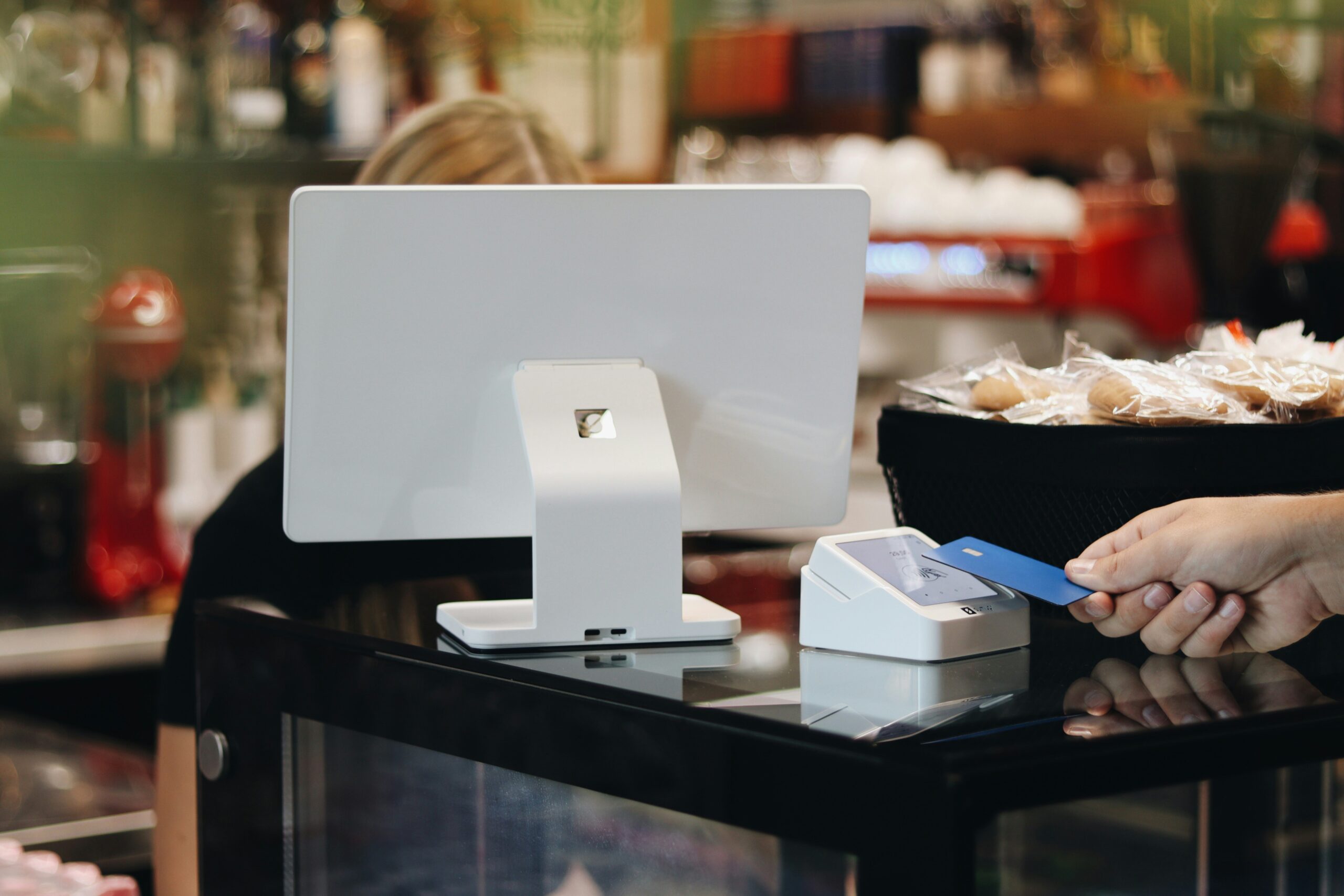
Choosing a card machine in the UAE is unusual in one specific way: you cannot find out what it costs before you talk to a salesperson. Of the seven major providers operating here, six will not publish a rate. That single fact shapes everything about how you should approach the decision.
This guide covers what the market actually charges, how to calculate your real cost rather than the advertised one, what matters in the hardware in 2026, and the contract terms that catch people out.
Key takeaways
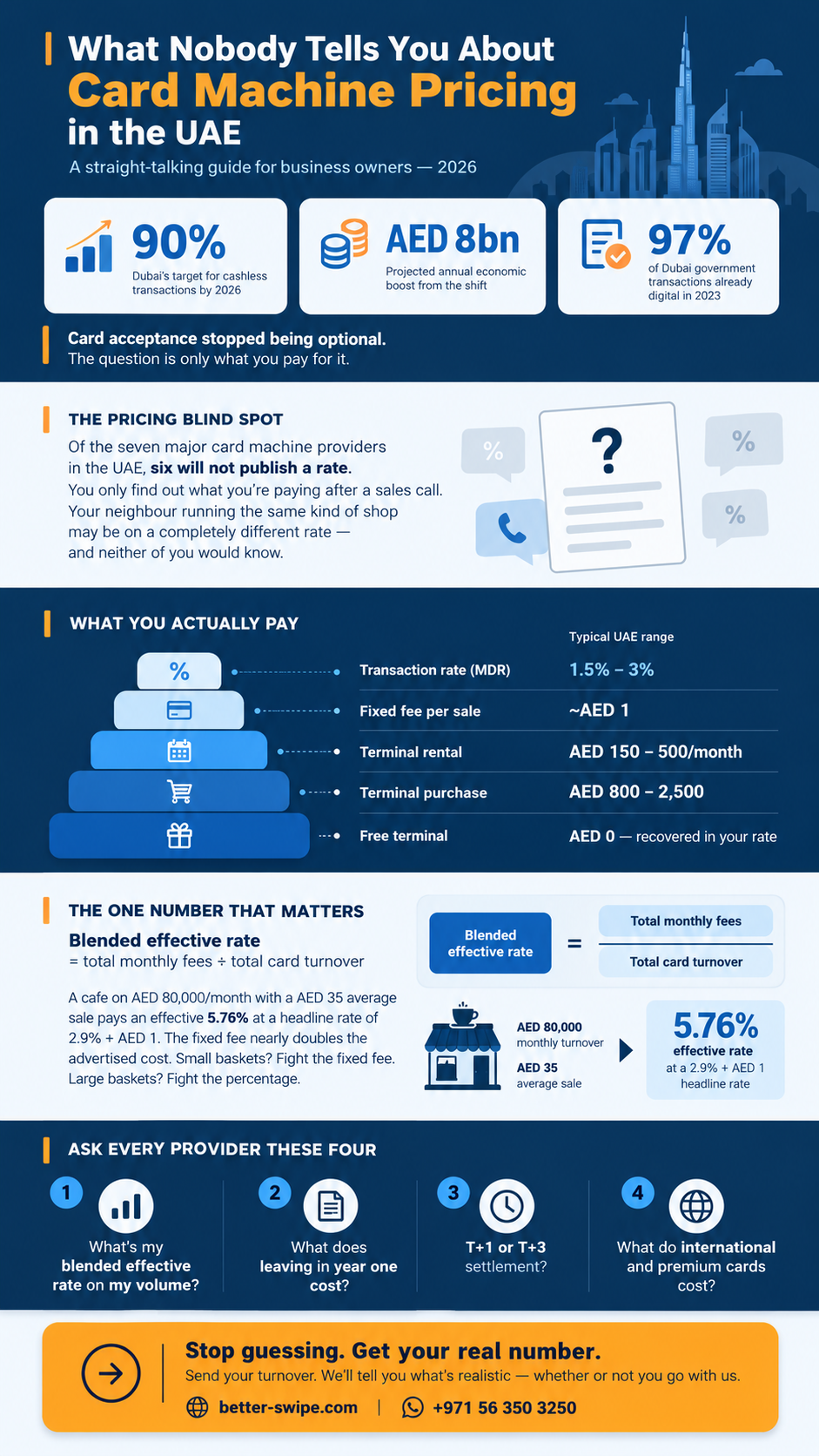
- Merchant discount rates in the UAE typically run 1.5% to 3%, plus roughly AED 1 per transaction. Only one major provider publishes a standard rate.
- Your blended effective rate — total fees divided by total card turnover — is the only figure worth comparing. It is frequently double the headline percentage.
- Terminal hardware costs AED 150 to 500 monthly to rent, AED 800 to 2,500 to buy, or nothing on qualifying accounts. It is the smallest number in the decision.
- Contract length and exit terms matter more than the rate. Check them first, not last.
- The UAE e-invoicing mandate is less urgent for retail merchants than most articles suggest. B2C sales are out of scope.
What a card machine actually is
The device on your counter is the visible part of something larger. Behind it sits a merchant account with an acquirer — the licensed institution that receives the funds from the card schemes and settles them to your business bank account.
This is why you cannot buy a card terminal online and start trading. The hardware is meaningless without an approved merchant account in your company's name, and that approval involves checks on your trade licence, your business activity and your risk profile. It is also why the terminal is cheap and the processing is not. You are buying a financial relationship, not a gadget.
Understanding this reframes the decision. You are not shopping for a device. You are negotiating a long-term financial contract, and the device arrives with it.
The pricing problem nobody mentions
Here is the UAE market as it actually stands. Network International, Magnati, Geidea, Mashreq NEOPAY, ADCB and AFS all price individually. None publishes a rate card. Paymob is the single exception, publishing 2.9% + AED 1 per transaction with no monthly subscription.
Quote-based pricing is not a conspiracy. Merchant rates are genuinely risk-based: a jewellery shop with a AED 4,000 average sale and a travel agency taking deposits twelve months ahead carry completely different chargeback exposure, and no single published number could serve both fairly.
But it has a practical consequence you need to internalise. The first quote you receive is a starting position, not a price. Merchants who get three quotes routinely end up with materially better terms than those who accept the first. The spread is not small.
Two structural details worth knowing before you sign anything long-term:
- Network International and Magnati are being combined. First Abu Dhabi Bank, with Brookfield and co-investors, acquired Network, and the two businesses are being brought under one holding entity. If you are signing a three-year agreement with either, ask directly how the integration affects your account management and support.
- AFS does not usually sell direct in the UAE. It is a processor, owned by a consortium of regional banks, that powers merchant acquiring for partner banks and brands. You will typically sign with a partner, and that partner sets your rate — so compare the partner's offer, not AFS's technology.
What you will actually pay
Six layers, only one of which usually appears in the sales pitch.
| Cost | Typical UAE range | Notes |
|---|---|---|
| Merchant discount rate | 1.5% – 3% | Lower end requires volume and low-risk category |
| Fixed fee per transaction | ~AED 1 | Punishing if your average sale is small |
| Terminal rental | AED 150 – 500/month | Usually bundles support and replacement |
| Terminal purchase | AED 800 – 2,500 | Cheaper over three years; you carry replacement risk |
| Setup fee | AED 0 – 2,000 | Often negotiable, frequently waived |
| Chargeback fee | AED 50 – 150 per dispute | Charged whether you win or lose |
Then the ones that appear only in the contract: minimum monthly charge, statement fees, PCI compliance fees, early termination penalties, and a higher rate band for international and premium cards.
Part of your rate is regulated, and you can look it up
Here is something almost no UAE guide mentions, and it changes how you negotiate.
Your merchant discount rate is not one fee. It is three things stacked: interchange (paid to the bank that issued your customer's card), scheme fees (paid to Visa or Mastercard), and your acquirer's margin. Only the third is negotiable — and until recently you had no way of knowing how big it was.
Since 1 October 2024 the Central Bank of the UAE has regulated interchange on domestically issued consumer debit and prepaid cards, and the schedules are published. For in-store transactions, Mastercard's UAE schedule sets:
| Card type | POS interchange | Cap per transaction |
|---|---|---|
| Standard, Gold, Titanium, Platinum | 0.75% | AED 37.50 |
| World, World Elite, all prepaid | 1.00% | AED 50.00 |
| Government and utilities | 0.50% | AED 25.00 |
| Transport | 0.50% | AED 25.00 |
| Petrol | 0.50% | AED 25.00 |
So on a standard domestic debit card paid in store, roughly 0.75% of your rate is a regulated floor your acquirer cannot change. If you are being quoted 2.6% on a customer base that is mostly local debit, the gap between 0.75% and 2.6% is scheme fees plus acquirer margin — and margin is where negotiation happens.
Two important limits. These caps cover domestic consumer debit and prepaid cards only. Credit cards sit outside this structure, and foreign-issued cards sit well outside it, which is why international transactions always cost more. And the card mix in your own business decides how much any of this matters — a tourist-facing shop in Deira has a very different blend from a neighbourhood grocery.
Still, walking into a pricing conversation knowing what the regulated floor is changes the dynamic considerably.
The only number worth comparing
Headline percentages are close to useless for comparison because they exclude the fixed fee, and the fixed fee behaves very differently depending on your average basket.
Take a Dubai cafe: AED 80,000 monthly card turnover, AED 35 average sale. That is about 2,285 transactions.
| At 2.9% + AED 1 | At 2.2% + AED 1 | |
|---|---|---|
| Percentage fees | AED 2,320 | AED 1,760 |
| Fixed fees | AED 2,285 | AED 2,285 |
| Monthly total | AED 4,605 | AED 4,045 |
| Blended effective rate | 5.76% | 5.06% |
The advertised rate was 2.9%. The real cost is 5.76% — almost double — because on a AED 35 sale the AED 1 fixed fee is itself worth 2.86%.
Now the same provider, same rates, for a furniture shop with a AED 1,200 average sale and the same AED 80,000 turnover. That is 67 transactions. Fixed fees total AED 67. The blended rate comes out at 2.98% — barely above the headline.
Same contract, wildly different real cost. If your average sale is small, negotiate the fixed fee and treat the percentage as secondary. If your average sale is large, the percentage is where your money is. Most merchants negotiate the wrong one.
What matters in the hardware
Less than providers would like you to think, but a few things genuinely matter in 2026.
Contactless and wallet support
Non-negotiable. Dubai is targeting 90% of transactions cashless by 2026, and roughly 85% of point-of-sale transactions were already cashless in 2024. Apple Pay, Google Pay and Samsung Pay support is a baseline expectation, not a feature.
Android smart terminals
Most new terminals run Android and can host apps — inventory, loyalty, booking, reporting — directly on the device. For a single-counter shop this may be irrelevant. For a restaurant wanting table management on the same device that takes payment, it removes an entire second system.
Dual connectivity and offline mode
A terminal with both Wi-Fi and mobile data keeps trading when one fails. Offline processing, which stores transactions and syncs them when connectivity returns, matters for anyone operating at events, in basements, or in buildings with unreliable Wi-Fi.
Dual language
Arabic and English on screen and receipts. Straightforward, and worth confirming rather than assuming.
PCI DSS compliance
Any legitimate provider meets this. It is a filter for eliminating unserious vendors, not a differentiator between real ones.
The e-invoicing question, answered properly
A lot of recent content implies UAE businesses must have e-invoicing-ready card machines by July 2026. For most retail merchants that is misleading, and it is worth being precise.
The UAE's Electronic Invoicing System follows a phased timeline:
- 1 July 2026 — pilot programme and voluntary adoption open. Not mandatory for anyone.
- 1 January 2027 — mandatory for businesses with annual revenue of AED 50 million or more.
- 1 July 2027 — mandatory for remaining in-scope businesses.
- 1 October 2027 — government (B2G) transactions.
Critically, the mandate covers B2B tax invoices. Business-to-consumer sales sit outside it until a later phase. So if you run a cafe, salon or retail shop selling to the public, your card terminal receipts are not what this regulation is about. If you invoice other businesses, it absolutely applies — but through your accounting system and an Accredited Service Provider, not through your card machine.
Do not let a deadline that does not apply to you rush a three-year contract decision.
Matching the setup to your business
| Business type | What fits | Negotiate hardest on |
|---|---|---|
| Cafe, bakery, kiosk | One countertop or handheld terminal | Fixed fee per transaction |
| Restaurant | Portable terminals for table payment, integrated POS | Fixed fee, plus tipping support |
| Salon, clinic | Single countertop terminal | Monthly minimum, contract length |
| Jewellery, furniture, electronics | Countertop with instalment plan support | Percentage rate, premium card bands |
| Delivery, events, pop-ups | Mobile terminal or SoftPOS on a phone | Hardware cost, offline capability |
| Tourist-facing retail | Any, with multi-currency handling | International card rate |
Documents and timeline
Expect 7 to 10 working days from a complete application. You will generally need:
- Valid UAE trade licence
- Passport, visa and Emirates ID copies for owners or partners
- Memorandum of Association for LLCs
- Corporate bank account details — settlement must go to a UAE business account
- Recent bank statements, typically three to six months
- Premises evidence such as a tenancy contract or Ejari
Incomplete documentation is the single most common cause of delay. Assembling everything before you apply is the easiest week you will ever save.
Six contract terms to check before the rate
- Term length and early exit cost. Three years is common. Ask the year-one termination figure in writing.
- Minimum monthly charge. A floor you pay regardless of takings — brutal for seasonal businesses.
- Settlement timing. T+1 versus T+3 is a real cash flow difference. Confirm whether faster settlement costs extra.
- International and premium card rates. Often a full percentage point higher. If tourists are a meaningful share of your customers, this reshapes your effective rate.
- Rate review triggers. Can they change your rate mid-term, and with what notice?
- Terminal ownership on exit. If you bought it, can you take it to another acquirer, or is it locked?
Frequently asked questions
How much does a card machine cost in the UAE?
Hardware runs AED 150 to 500 per month to rent or roughly AED 800 to 2,500 to buy, and is free on qualifying accounts with some providers. The larger cost is processing: 1.5% to 3% of each transaction plus around AED 1 fixed.
Which card machine provider is best in the UAE?
There is no single best provider — it depends on your transaction volume, average sale value and industry. High-volume merchants get better rates from the large acquirers. Small or new businesses often do better with a provider offering transparent pricing and no long contract.
Can I get a card machine without a UAE bank account?
No. Settlement must go to a UAE corporate bank account in your business's name. This is a regulatory requirement, not a provider preference.
Can I charge customers a fee for paying by card?
Generally no. Card scheme rules in the UAE prohibit surcharging customers for card payments, and processing costs are treated as a merchant business expense. Build the cost into your pricing instead.
How long does approval take?
Typically 7 to 10 working days from a complete application. Specialist payment providers are often faster than traditional banks.
What is a good transaction rate in the UAE?
For an established business with steady volume in a low-risk category, under 2% is competitive. New businesses and higher-risk categories are usually quoted 2.2% to 2.9%. Always compare the blended effective rate rather than the headline percentage.
Should I rent or buy my terminal?
Buying is usually cheaper across three years and gives you more leverage when renegotiating. Renting preserves cash flow and includes support and replacement. If you might switch provider within two years, owning your hardware helps.
Does my card machine need to be e-invoicing compliant?
For business-to-consumer retail sales, no — B2C transactions are outside the current UAE e-invoicing mandate. If you issue B2B tax invoices, the mandate applies from January 2027 or July 2027 depending on your revenue, and compliance runs through your accounting system and an Accredited Service Provider rather than your card terminal.
Comparing specific providers? See our UAE POS machine comparison, covering Network International, Magnati, Geidea, Mashreq NEOPAY, ADCB, AFS and Paymob side by side. Working out a budget? Read what a POS machine really costs in the UAE.
Find out what you should be paying
Send your monthly card turnover and business type. We will tell you what is realistic for your profile.
